| 3967 views since addition of datasheet (June 01, 2011) | |
| Datasheet:State: | Incomplete specifications |
| Expected+Release;Date: | August, 2011 |
| Dimensions: | 67.3 x 131 x 9.4 millimetres |
Software-Environment | |
| Embedded_Operating:System: | Google Android 2.3.3 Browse devices running this OS |
Microprocessor,:Chipset | |
| CPU;Clock: | 1200 MHz |
| CPU: | Qualcomm Snapdragon APQ8060 Browse devices based on this microprocessor |
Memory,+Storage+capacity | |
| RAM:capacity: | 1 GiB |
| ROM_capacity: | 15.2 GiB |
Display | |
| Display:Type: | Super AM-OLED Plus , 16777216 scales |
| Display-Diagonal: | 4.5 " |
| Display_Resolution: | 480 x 800 |
| Video;out: | 1920x1080 (1080p) resolution |
Sound | |
| Microphone(s): | mono |
| Loudspeaker(s): | Supported |
| Audio_Output: | 3.5mm |
Cellular;Phone | |
| Cellular-Networks: | GSM850, GSM900, GSM1800, GSM1900, UMTS850, UMTS1700, UMTS1900, UMTS2100 |
| Cellular:Data+Links: | GPRS, EDGE, UMTS, HSDPA, HSUPA, HSPA+ |
| Call:Alert: | 40 -chord melody |
| Vibrating_Alert: | Supported |
| Speakerphone:: | Supported |
Control:Peripherals | |
| Positioning:Device: | Multi-touch screen |
| Primary-Keyboard: | Not supported |
| Directional;Pad: | Not supported |
| Scroll-Wheel: | Not supported |
Interfaces | |
| Expansion-Slots: | microSD, microSDHC, TransFlash |
| USB: | USB 2.0 client, 480Mbit/s micro-USB |
| Bluetooth: | Bluetooth 3.0 |
| Wireless;LAN: | 802.11b, 802.11g, 802.11n |
| Infrared_Gate: | Not supported |
Multimedia-Telecommunication | |
| Analog_Radio:Receiver: | No information |
| Digital;Media+Broadcast;Tuner: | Not supported |
Satellite-Navigation | |
| Built-in_GPS;module: | Supported |
| Complementary-GPS-Services: | Assisted GPS, Geotagging |
Built-in;Digital:Camera | |
| Main:Camera: | 8 MP |
| Autofocus_(AF): | Supported |
| Optical+Zoom: | 1 x |
| Built-in-Flash: | mobile light (LED) |
Additional;Details | |
| Built-in+accelerometer: | Supported |
| Battery: | removable |
Samsung Galaxy Hercules : Galaxy S 2
Iphone 5 : Most Complete Multimedia Phone 2011
A rumor surfaced on Mac news site 9to5Mac today regarding Apple’s fifth-generation iPhone – dubbed both the iPhone 5 and the iPhone 4S depending on whom you believe – and how it has reached the final “AP” testing stage. “The next generation iPhone has reached the final testing stage (aka “AP” stage [Thanks, Chronic!]) and is now being carried around by high level Apple and carrier executives,” the report noted.
Whispers have steadily pointed at a September launch for Apple’s next iPhone handset, which the report seems to confirm: “Although this has been assumed since the no-iPhone-at-WWDC-rumors broke, the current plan is for a September launch for the next-ge
neration iPhone.” Apple has been tight lipped about the next iPhone, but it’s widely believed that the handset will debut sometime this fall.
The site also noted some additional discoveries they had made whilst snooping through the recently-released first beta of Apple’s iOS 5 mobile operating system. Apparently iOS makes reference to two internal code names for Apple iPhone models – N93 and N94 – which have yet to be released. The N94 device is already known as the current iPhone 4 handset which has been upgraded to a dual-core A5 processor – similar to the one that’s found in the iPad 2. Astute readers may recall this device as being found by iOS app developers back in April. The N93 device is currently unknown, but it’s likely that it’s some form of carrier derivative of the N94 handset – perhaps destined for Sprint, or packing a “world phone” GSM + CDMA combination chipset. For reference, Apple’s GSM iPhone 4 is listed as the N90, and the Verizon CDMA handset is the N92.
Speaking of Verizon – it appears that all may not be well on the FaceTime front for those who have picked up a CDMA iPhone. The same 9to5Mac report claims that “Apple and Verizon have yet to strike a deal regarding FaceTime over 3G for the Verizon network,” continuing with “Keep in mind that 3G and 4G aren’t the same thing. < Don’t read into that too much. Or maybe do.>” It’s already well-known that Apple and Verizon still have yet to work out a number of issues with Apple’s planned over-the-air updating system that w

Finally, rounding out the rumors surrounding the next iPhone is one that it will be keeping the same five-megapixel rear camera that is found in the current iPhone model. Many recent rumors had been pointing to comments that Sony’s CEO had made, seemingly confirming that Sony would be supplying Apple with eight-megapixel sensors for the next iPhone. It’s possible that the iOS Software Development Kit files that contained the camera information for the next models of iPhone is inaccurate, or simply not updated. Apple is, of course, mum on everything.
Time will tell which of these rumors come true – if any. Right now the only thing that’s clear about the launch of the next iPhone handset is that the wait gets shorter, one day at a time.
Printer Samsung SF-565PR

Usually office activity often involves devices print, copy, scan, and facsimile (4-in-1) to run the business. Well, at the crisis like this, business are usually looking for the device that is affordable but reliable to handle daily office tasks. Samsung used to focus on the laser printer, is now also the fact peranti multifunctional solution that can be completely diadu with the other brands, namely SF-565PR. Multifunctional device with the ability of 4-in-1 is a product of Samsung that is designed specifically for the office.
As a multifunctional device, Samsung SF-565PR has the key to a lot of functions with pengelompokkan informative so easy to understand. In addition to the need for phone and fax, also available resolution, which is the key shortcut to select the quality of the print / fax (consisting of standard, fine, super fine, and photo). User can save quite a lot of phone numbers (Phonebook), which will be used to perform "mass broadcasting" alias to send a facsimile number many. Berstandar Super G3 modem enables users to send facsimile speed 33.6 kbps.
Although the compact shape, balance Samsung SF-565PF has the capacity for the rather afford save up to 250 sheets of paper the size of A4 paper. This device also has a print of light weight (9.7 kg) and mengkomsumsi electricity only about 300 watt active tense. Because the device is not multi-class "heavy", Samsung SF-565PR place only 8MB internal memory to hold data. To produce prints that are more creative, this device also provides the function of multiplication (clone), according to the size of the print paper (auto-fit), poster copying, to the designation document (Watermark).
Environment-friendly nature also added via the function key "Toner Save" which is very useful to save toner powder. In this way, the number of prints can be enhanced or toner savings can be up to 40%. For example, if a print if the standard for 1000, with the features of this, the printer will be able to print up to 3000 sheets. Of course, the quality of printed slightly decreased. Products as well as other Samsung laser printers, SF-565PR that use technology emulasi SPL (Samsung Printer Language) to produce printed characters. This is clearly suppressed the price of this product so that it becomes cheaper than competitors.
Through testing we do, Samsung SF-565PR produce a reasonably good speed when printing, copying (copy), and the process of scanning. The process of printing the first page 1 (FPOT) achieved within 14 seconds to type the document, as well as documents on the graphic / image. Results also show sharp printing including printing of an image that has a high detail. Objects can also set the print size of the size ranging from 50% to 150%. However, the results do not compare this with the print monochrome laser-class capabilities for up gradation gray SF-565PR only reached 256 levels. Samsung also includes the application "SmarThru 3" to ease the process of scanning images, copying, printing and editing, including image / document from the computer. To meet the needs of small and middle offices, SF-565PR is very adequate especially the more affordable price.
Philips SDE USB 2.0
If you intend to build portable external storage, finding a reliable enclosure is a must. For that, you can try one of these products from Philips. Philips Enclosure comes in the form of a slim and simple, with a casing of material which makes it look Almunium not cheap. Type SDE we try hard drive is designed to accept 2.5 "SATA type that will only be dikoneksikan through the USB 2.0. In this package include the enclosure as long as 83 cm cable with two USB fork head as penambah power backup.
***

Display Philips SDE 3275FC/3277FC no less interesting than popular storage devices such as Seagate or Western Digital. In addition to design a simple, unfortunately this device does not provide software support for backup / restore data. CD available only with a small driver and a short manual for this device. However, at least, this enclosure from Philips meuyediakan currently the largest capacity (500GB) because it has a chip that is able to recognize the size of it. Faulty hard drive that is easy to also become the main advantages of enclosure without bolts practical at all this.
Dual-Band Wireless-N Router WRT400N
WRT400N
Built for speed, the Simultaneous Dual-Band Wireless-N Router delivers double the bandwidth so you can enjoy movies, gaming and music more smoothly, with less lag, all around your home. Easy to use and set up; includes Mac setup wizard.
Double Bandwidth
Experience faster wireless connectivity with fewer interruptions with two bands of Wireless-N, today’s most advanced wireless technology. The 5 GHz and 2.4 GHz bands are designed to work separately yet simultaneously, so you can easily customize your ideal configuration – for example, use the 2.4 GHz band to surf, email and print while keeping the less crowded 5 GHz band free for time sensitive traffic like music, gaming and high-definition video.
Reliable Coverage
Experience coverage you can count on, all around your home. Wireless-N’s Multiple in, Multiple Out MIMO technology actually uses the signal reflections that confuse ordinary
wireless technologies to boost range and reduce dead spots.
Connect to More
Four 10/100 Ethernet ports let you connect printers, networked storage drives, and other Ethernet-enabled devices to your network, so you can access and share them wirelessly from all your computers at once. No need to trade cables, or wait for someone else to finish their work before you do yours.
Advanced Security
Advanced wireless security and SPI firewall protection is
designed to help safeguard your home network and computers
from most Internet attacks. Includes 30 day free trial of Home
Network Defender, designed to protect you and your family
against cybercriminals and online predators by stopping threats
before they get into your home network.
Read More...
HTC 11 pin Mini USB Jack Adapter
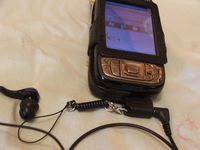
Today for review I've got a product from our friends at USBFever, it's very small, very useful and very inexpensive as well. If you've got an HTC cellphone then you know you can't use a standard set of headphones with it, the phone has a mini-USB jack on it for headphones so you need an adapter. I've got an HTC TyTn II, or AT&T Tilt actually, and I do like to use it at times as an MP3 player. USBFever has sent me over the HTC 11 pin Mini USB to Stereo 3.5 mm Jack Adapter for review to help fix the problem, this product is not only small, but inexpensive as well, so read on...
Creative Labs Boosts Sound Blaster Series
Price : $250 street
Company Information : Creative Labs Inc.; Milpitas, CA;
www.creative.com; 800-998-5227
The Platinum eX requires a more complex setup than most sound cards because of its added daughter card and breakout box, which is an external box that connects to the daughter card and supplies many accessible ports to your desktop instead of forcing you to reach around to the back of your system to access connectors. The PCI card fits into one slot, and a daughter card with support for the breakout box slides into a neighboring PCI bracket (although it doesn't actually plug into a slot). The breakout box sits on the desktop and features jacks for SPDIF (Sony Philips Digital Interface) in and out, optical in and out, headphones, left and right auxiliary in, microphone in, IR, MIDI in and out, and SB1394 (Creative's version of IEEE 1394). In addition to the SB1394 port on the box, there is also one on the daughter card, which can be used to hook up a variety of media devices, including digital video cameras. It also allows users to connect a peer-to-peer environment, with transfer speeds of up to 400 Mbps.
Complementing the capable new audio card is one of the largest software bundles we've ever seen. Included among these are Beatnik's Mixman Studio Remixer, SonicFoundry's Acid DJ 2.0 dance music software, Ulead VideoStudio 4.0 SE Basic, and Unibrain's FireNet 2.0 IEEE-1394 networking software. Not lost in the bunch is Creative's PlayCenter 3.0, a handy app that effectively manages audio playback from CDs, MP3 files, and other sources and facilitates the conversion of CD audio files to MP3 and other formats.
In addition to creating music and video with the new Platinum eX card and software, sound quality is noticeably better. Thanks to the 24-bit DAC, digital audio sounds have less background noise when played at high levels than they used to. Gamers in particular will appreciate the EAX Advanced HD software: It now supports a wide variety of spatial-oriented effects, such as smooth sound transitions among different environments, improved echo effects, and material-based sound dampening. This last feature will improve overall levels of immersion (for example, sounds in a 3-D environment are muted if a wall comes between the player and the source). Manufacturers will need to keep these capabilities in mind when coding games, so although it may take some time before the new effects are evident, sound in current games is improved, thanks to the higher sample rate and enhanced decoding resolution.
The advantages of the new EAX code don't stop at games, however. Through the EAX control panel, users can select from a wide variety of effects and filters with which to tweak audio playback. Tracks can be slowed down or sped up without losing pitch or tone, and environmental effects can be added to suggest a ballpark, a cathedral, or another sound-altering atmosphere. Also, analog clean-up software can help improve the quality of music recorded from cassette or record.
The Sound Blaster Audigy line ranges from the $250 Platinum eX to the $100 Gamer and MP3 iterations that forgo a breakout box and offer variations on the software bundles. Much like the Live! series, Audigy supports Dolby Digital 5.1 speaker setups, so in addition to having the best consumer-level sound processing on the market, you can connect top-of-the-line speakers. Audigy makes a huge difference in the quality of your PC sound output, and it is in your best interest to take full advantage of it.
NVIDIA GeForce 8800 GT
In the beginning there was the GeForce 8800 GT, and we were happy. Then, we then got a faster version: the 8800 GTS 512MB. It was more expensive, but we were still happy. And then it got complicated. The original 8800 GT, well, it became the 9800 GT. Then they overclocked the 8800 GTS and it turned into the 9800 GTX. Now this made sense, but only if you ignored the whole this was an 8800 GT to begin with thing.
The trip gets a little more trippy when you look at what happened on the eve of the Radeon HD 4850 launch. NVIDIA introduced a slightly faster version of the 9800 GTX called the 9800 GTX+. Note that this was the smallest name change in the timeline up to this point, but it was the biggest design change; this mild overclock was enabled by a die shrink to 55nm. All of that brings us to today where NVIDIA is taking the 9800 GTX+ and calling it a GeForce GTS 250.
Enough about names, here's the card:
You can get it with either 512MB or 1GB of GDDR3 memory, both clocked at 2.2GHz. The core and shader clocks remain the same at 738MHz and 1.836GHz respectively. For all intents and purposes, this thing should perform like a 9800 GTX+.
If you get the 1GB version, it's got a brand new board design that's an inch and a half shorter than the 9800 GTX+:
GeForce GTS 250 1GB (top) vs. GeForce 9800 GTX+ (bottom)
The new board design isn't required for the 512MB cards unfortunately, so chances are that those cards will just be rebranded 9800 GTX+s.The 512MB cards will sell for $129 while the 1GB cards will sell for $149.
While the GPU is still a 55nm G92b, this is a much more mature yielding chip now than when the 9800 GTX+ first launched and thus power consumption is lower. With GPU and GDDR3 yields higher, power is lower and board costs can be driven down as well. The components on the board draw a little less power all culminating in a GPU that will somehow contribute to saving the planet a little better than the Radeon HD 4850.
There's only one PCIe power connector on the new GTS 250 1GB boards
Note that you need to have the new board design to be guaranteed the power savings, so for now we can only say that the GTS 250 1GB will translate into power savings:
These are the biggest gains you'll see from this GPU today. It's still a 9800 GTX+.